 By Prabha Bhaskar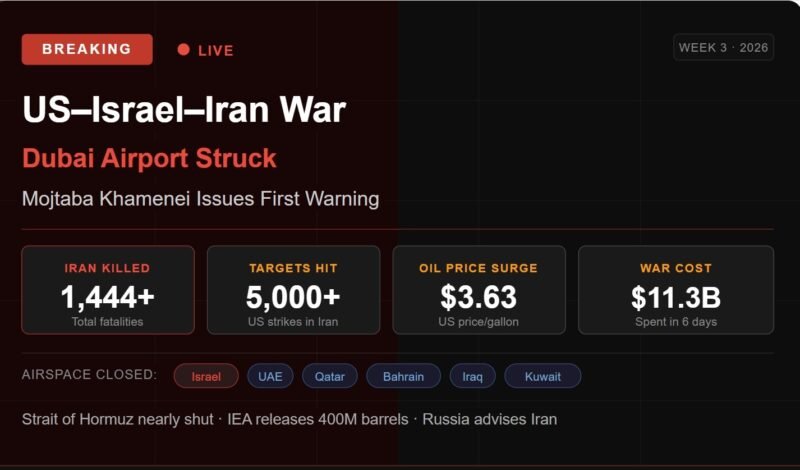
Breaking News | Middle East Crisis | March 14, 2026:
The Middle East is burning. As the US-Israel military campaign against Iran enters its third week, the conflict has spilled far beyond Iranian borders — hitting Gulf airports, disrupting global oil supplies, and pulling major world powers into a rapidly expanding war. Here is everything you need to know right now.
What Is Happening Right Now?
A fresh wave of Iranian ballistic missiles struck northern Israel early Friday, injuring civilians and damaging residential buildings. In response, US and Israeli forces carried out another round of precision airstrikes deep inside Iranian territory targeting military command centres and missile storage facilities.
Iran’s newly appointed Supreme Leader Mojtaba Khamenei — who has not been seen publicly since taking charge — delivered his first recorded message through Iranian state television. He warned that attacks on Israel and US military assets in the region will not stop until every American military base in the Middle East is shut down.
US Defense Secretary Pete Hegseth dismissed the statement, calling it proof that Iran’s new leadership is “desperate, scared, and backed into a corner.”
Death Toll & Casualties: How Bad Is It?
The human cost of this war is staggering and rising by the hour.
- Over 1,400 people killed in Iran since hostilities began
- At least 15 Israeli civilians have lost their lives
- 11 US military personnel have been killed in active combat
- 19 deaths reported across Gulf nations, including the UAE
In one of the most tragic non-combat incidents of this war, all six crew members of a US Air Force refuelling aircraft died when their plane crashed in western Iraq. Investigations suggest a mid-air collision with a second US tanker was involved — the aircraft had no ejection systems onboard.
Dubai Airport Struck — Gulf Nations Are Now in the Crossfire
The war took a dramatic turn this week as Iran shifted its sights toward Gulf infrastructure:
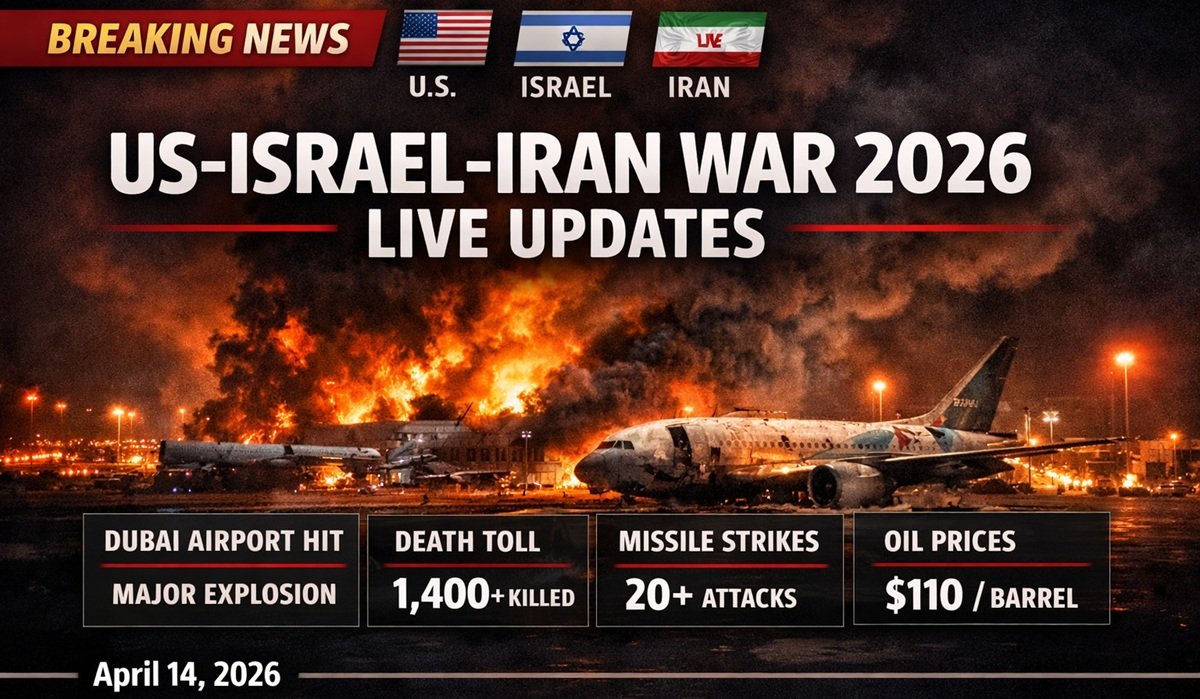
- Dubai International Airport was struck in an Iranian missile and drone attack, causing significant damage to terminals and grounding hundreds of flights
- Several hotels in the UAE were also hit in the same wave of attacks
- The UAE intercepted a massive barrage including 6 ballistic missiles, 7 cruise missiles, and 39 drones in a single night
- Qatar has closed its airspace entirely, though Qatar Airways has arranged over 140 special evacuation flights for stranded passengers and residents
- Saudi Arabia intercepted 10 drones over its eastern region before destroying 28 more that entered its airspace
Gulf nations, which had maintained a delicate neutrality, are now openly condemning the Iranian strikes.
Global Fuel Crisis: Oil Prices Are Spiking
The Strait of Hormuz — one of the most critical shipping lanes on Earth — has effectively shut down due to the ongoing conflict. The impact is being felt worldwide:
- US pump prices have climbed to $3.63 per gallon, a 22-month high
- Global crude oil prices have surged as tanker traffic through Hormuz grinds to a near halt
- The International Energy Agency (IEA) has agreed to release a record 400 million barrels of crude oil from strategic reserves to stabilise global energy markets
- The UN World Food Programme has issued an urgent warning about long-term food price increases, as nearly half of all global urea and sulfur exports pass through the Strait of Hormuz
Analysts warn that if the blockade continues beyond 30 days, several developing nations could face severe fuel shortages by April.
US Military Escalation: More Troops, More Drones
Washington is doubling down on its military presence across the region:
- A Marine Expeditionary Unit of approximately 2,200 soldiers has been deployed from Okinawa, Japan, to the Middle East
- The US Army has dispatched 10,000 Merops interceptor drones to protect assets and personnel across the theatre
- US CENTCOM has confirmed striking more than 5,000 targets inside Iran since the campaign began on February 28
However, the war is facing growing opposition at home. More than 250 American organisations have jointly signed a letter urging Congress to halt war funding, pointing out that the conflict consumed over $11.3 billion in its first six days alone — money they argue should be spent on domestic food assistance and public services.
Iran Fights Back: Hezbollah Joins, Russia Advises
Iran is not fighting alone. New intelligence has added alarming new layers to this conflict:
- Iran’s Islamic Revolutionary Guard Corps (IRGC) claimed a joint five-hour sustained assault alongside Lebanon’s Hezbollah, hitting more than 50 Israeli targets simultaneously in a coordinated attack
- A Western intelligence official has revealed that Russia is actively providing Iran with specific drone strike tactics — going beyond general assistance to hands-on targeting guidance for hitting US and Gulf positions
- Explosions also rocked a pro-government rally in Tehran attended by President Masoud Pezeshkian and senior Iranian officials, killing at least one person in a suspected Israeli covert operation
How the World Is Reacting
World leaders are watching with alarm as the conflict threatens to destabilise the entire global order:
- UK Prime Minister Sir Keir Starmer, alongside France and Germany, has condemned Iranian retaliatory strikes while also making clear that he does not support “regime change from the skies”
- The International Maritime Organization (IMO) has called an extraordinary emergency session to address the growing threat to international shipping in the Strait of Hormuz
- Australia has ordered all non-essential government officials to leave the UAE and Israel, urging its citizens to evacuate the region while commercial flights are still available
FAQs: US-Israel-Iran War 2026
Q1. When did the US-Israel war on Iran begin? The conflict officially began on February 28, 2026, when the US and Israel launched coordinated surprise airstrikes across multiple sites in Iran, killing Supreme Leader Ali Khamenei along with several top military commanders.
Q2. Who is Iran’s new Supreme Leader? Mojtaba Khamenei, son of the late Supreme Leader Ali Khamenei, has been appointed to lead Iran. He reportedly sustained minor injuries during the initial strikes and has not appeared in public since taking power.
Q3. Is the Strait of Hormuz open for shipping? No. Tanker traffic through the Strait of Hormuz has nearly halted completely. This is creating a ripple effect across global oil, gas, and food supply chains.
Q4. How many targets has the US struck in Iran so far? As of March 10, 2026, the US military has confirmed striking more than 5,000 targets inside Iran, including missile launch sites, IRGC bases, and military command infrastructure.
Q5. Are flights operating in the Middle East? Major airspaces including Bahrain, Iraq, Israel, Kuwait, Qatar, Syria, and the UAE are fully or partially closed. Most international airlines have suspended their Middle East routes until further notice.
Q6. Is this war likely to spread further? With Hezbollah now actively involved, Russia providing tactical support to Iran, and Gulf nations being directly attacked, military analysts warn the conflict has moved into a multi-front regional war — with the risk of further escalation remaining very high.
Must Read: NASA Satellite Crashes: What Really Happened in 2026?