 By Prabha Bhaskar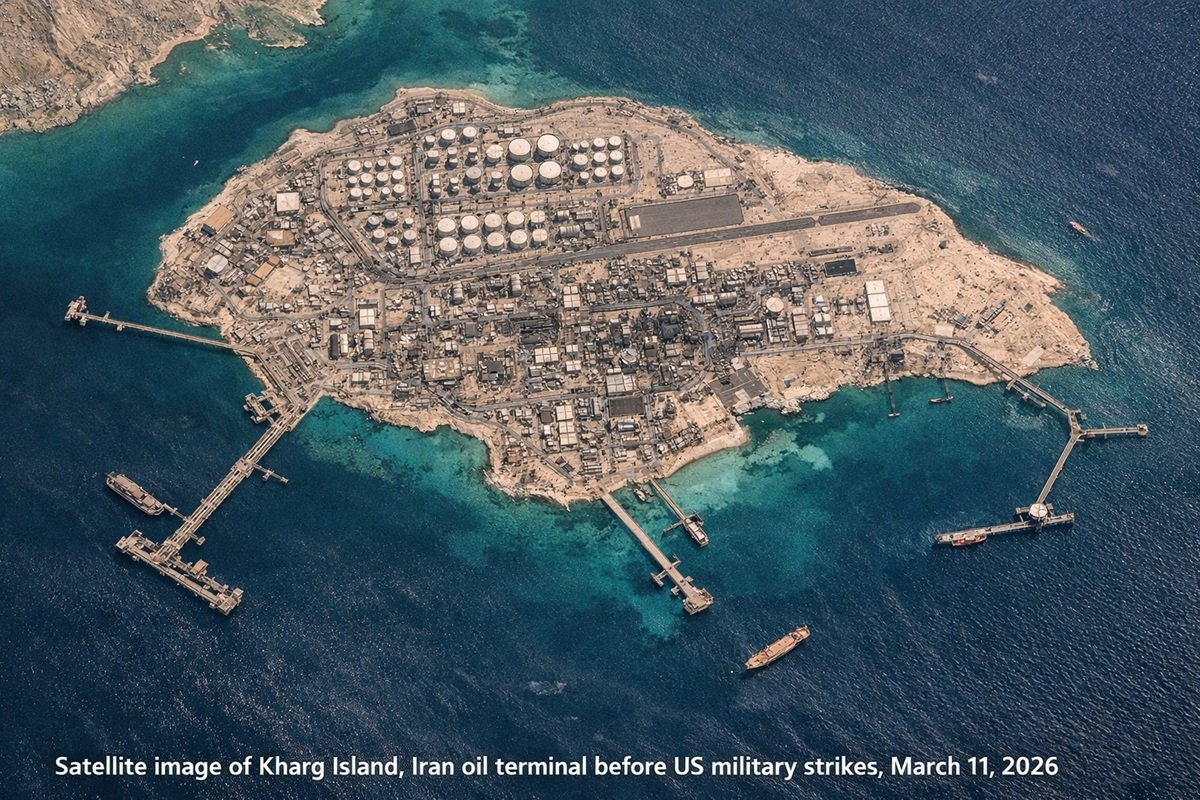
For two full weeks, as missiles and bombs rained across Iran, one tiny island in the Persian Gulf stayed eerily untouched. Military analysts watched it. Oil traders held their breath. The world waited.
Then, on the night of March 13–14, 2026 — it happened.
President Donald Trump announced that he directed U.S. Central Command to carry out what he called “one of the most powerful bombing raids in the History of the Middle East,” targeting Iran’s Kharg Island — the small but strategically priceless island that handles roughly 90% of Iran’s entire crude oil exports.
The island known among Iranians as the “Forbidden Island” is forbidden no more. It is now a battleground — and the entire world is watching what comes next.
What Just Happened at Kharg Island? (Breaking, March 14, 2026)
President Trump said US forces “obliterated” Iranian military targets on Kharg Island and warned that oil infrastructure there could be attacked next. Following the strikes, Iran’s Islamic Revolutionary Guard Corps (IRGC) informed the United Arab Emirates that US “hideouts” are “legitimate targets.”
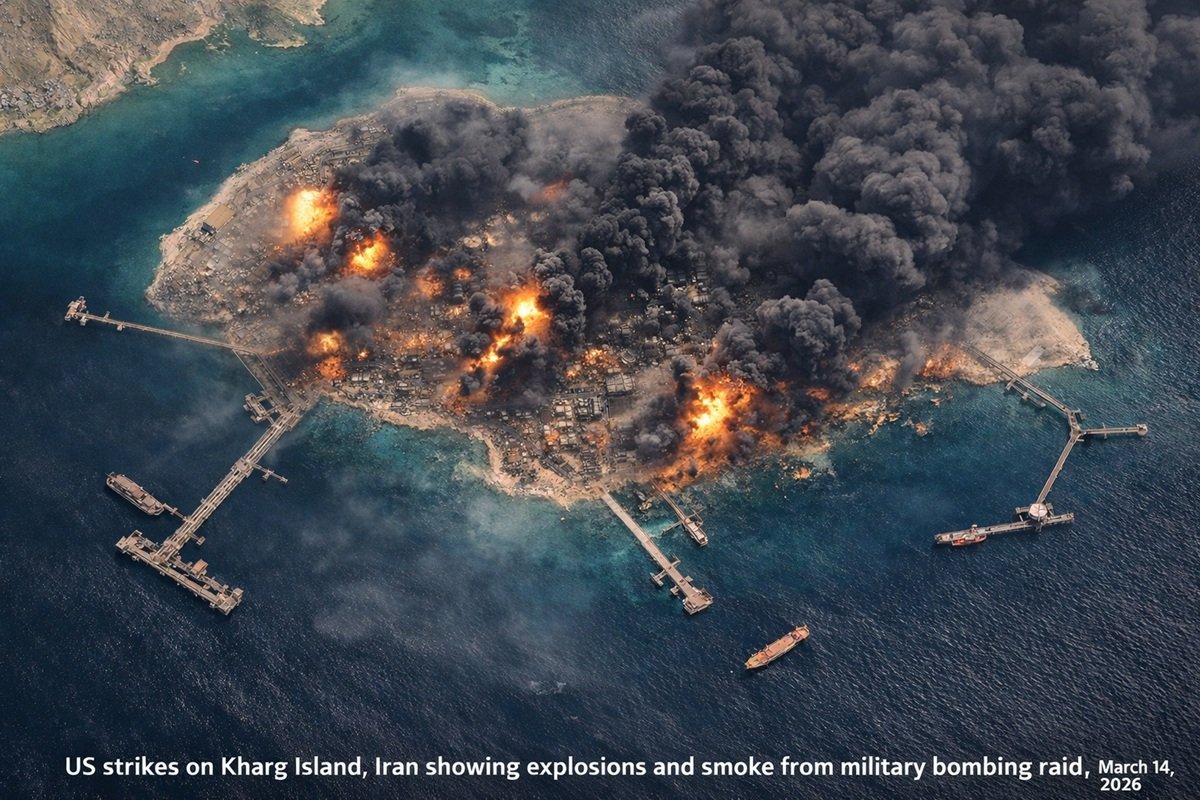
Iran’s semi-official Fars news agency reported, quoting sources, that more than 15 explosions were heard on Kharg Island during the US attacks. The sources said the attacks targeted air defences, a naval base, and airport facilities. Fars also reported thick smoke rising from the island.
Early Saturday, U.S. Central Command posted a video of strikes on naval mine storage facilities, missile storage bunkers, and other military sites. “U.S. forces successfully struck more than 90 Iranian military targets on Kharg Island, while preserving the oil infrastructure,” CENTCOM stated.
This is not just a military strike. This is a direct message to Tehran — and to every oil market in the world.
What Is Kharg Island? Location & Map Explained
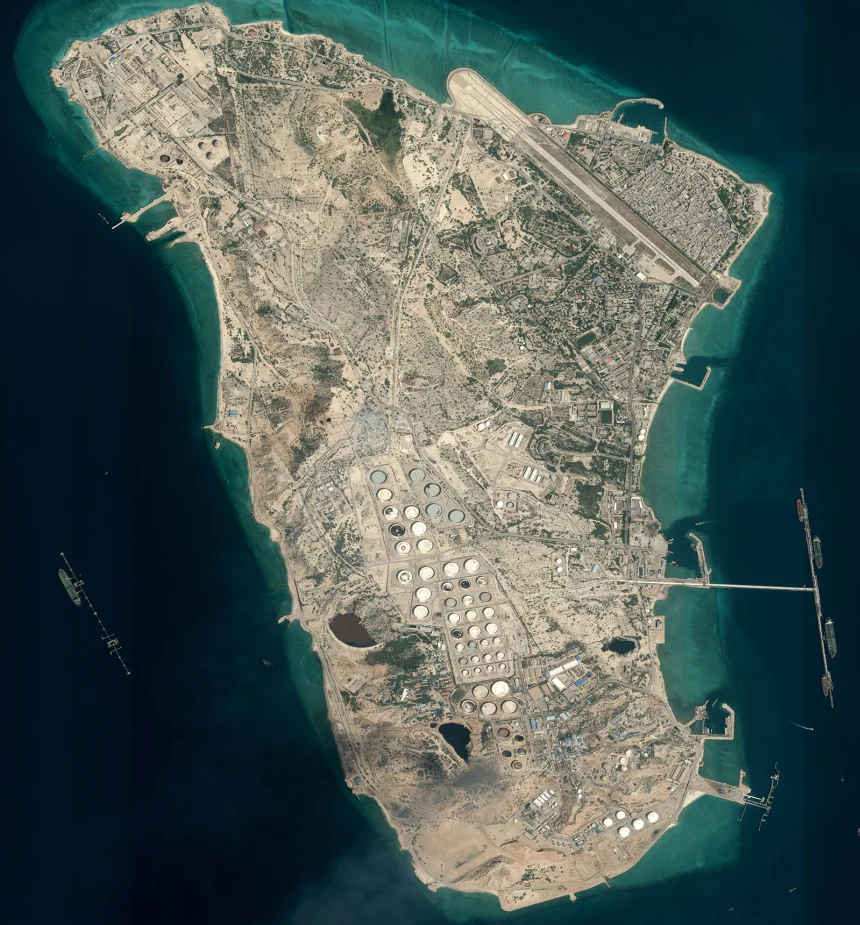
Kharg Island is a coral outcrop around a third of the size of Manhattan, located just 25 kilometers off Iran’s coast in the Persian Gulf. Almost every day, millions of barrels of crude oil gush from Iran’s major fields — including Ahvaz, Marun and Gachsaran — through pipelines to the island. Its long jetties, jutting into waters deep enough to accommodate oil supertankers, make it a critical site for oil distribution.
Located 55km northwest of the Bushehr port and 15 nautical miles from the Iranian mainland, Kharg Island is the undisputed economic backbone of Iran. The island processes 90% of the nation’s total oil exports, handling approximately 950 million barrels every year.
On any Kharg Island map, you’ll find it sitting almost perfectly between Iran’s oil fields and the Persian Gulf shipping lanes — which is exactly why it matters so much, and why losing it would be catastrophic for Tehran.
Why Kharg Island Is Iran’s Economic Lifeline
The numbers are staggering. The terminal receives crude from three major offshore fields — Aboozar, Forouzan and Dorood — which is then transported via a complex network of subsea pipelines to onshore processing facilities before being stored or shipped to global markets.
The island also houses the Kharg Petrochemical company, along with a large installation used to store and export oil and liquefied natural gas.
A CIA document from 1984 said the facilities are “the most vital in Iran’s oil system, and their continued operation is essential to Iran’s economic well-being.” CNN Forty years later, that assessment has only become more accurate.
The island has been loading tankers “non-stop since the war broke out,” according to TankerTrackers.com, which uses satellite imagery to track crude oil shipments. In the weeks leading up to the US-Israeli strikes on Iran, exports from Kharg were ramped up to near-record levels, according to JP Morgan.
Iran knew what was coming. And it was racing to ship as much oil as possible before it did.
What the US Actually Targeted — And What Was Spared
This is where it gets strategically fascinating.
Trump wrote that he had “chosen NOT to wipe out the Oil Infrastructure on the Island.” He then added a direct warning: “However, should Iran, or anyone else, do anything to interfere with the Free and Safe Passage of Ships through the Strait of Hormuz, I will immediately reconsider this decision.”
In plain terms: the US destroyed Iran’s military presence on the island but left the oil taps running — for now. The oil infrastructure is being used as a bargaining chip, not a bomb target. At least today.
A retired army official told CNN the strike has “raised the stakes in the war.” He said the US is essentially holding the island “hostage” to ensure Iran allows ships through the Strait of Hormuz, whose closure has already sent crude oil prices soaring.
Iran’s Response and Retaliation Threat
Tehran did not stay silent.
Tehran warned that any attack on its energy facilities would trigger retaliation against regional oil infrastructure and US-aligned assets, raising fears of a wider energy and security crisis across the Gulf.
Iran has said any attack on its oil and energy infrastructure will lead to retaliatory strikes on facilities in the region owned by oil companies that have American shares or cooperate with the United States.
Al Jazeera’s Mohamed Vall, reporting from Tehran, said Iran’s potential retaliatory attacks on Gulf oil facilities would be a “catastrophic scenario” for the region, and for the “entire industry of oil and gas.”
The IRGC has also made a chilling declaration — Iran’s Islamic Revolutionary Guard Corps informed the United Arab Emirates that US “hideouts” are now “legitimate targets.” The Gulf states, many of which host US military infrastructure, are now directly in the crosshairs.
What Happens to Global Oil Prices Now?
The oil market was already under severe stress before the Kharg Island strikes.
The price of Brent crude, the global benchmark for oil, settled at over $100 a barrel on Friday — a gain of more than 40% since the war began in late February.
An attack on oil infrastructure would also likely prompt further energy market volatility at a time when oil prices have soared to nearly $120 a barrel.
The worst-case scenario, according to analysts, is even more alarming. JPMorgan analysts said if Kharg Island were disabled, the loss of Iran’s storage buffer and the scarcity of viable export alternatives would “rapidly trigger upstream shut-ins across major southwest fields,” with as much as half of national oil output potentially at risk.
For Indian consumers, for Asian economies, and for any country that imports oil — this is not a distant war. It is arriving at your petrol pump.
Could the US Seize Kharg Island?
This question has been circulating in war rooms and newsrooms for days.
Trump has long mused about seizing Kharg Island — at least as far back as 1988. The Trump administration reportedly discussed seizing the island as recently as March 7, 2026, according to an Axios report.
Francis Galgano, a military geography specialist at Villanova University, said bluntly: “If the objective is to win the war quickly, you destroy or capture Kharg immediately.”
But analysts warn it’s not that simple. Any attempt to seize the island would create a “very aggressive” response from the regime and would expose US troops to drone and missile fire, according to experts.
The Pentagon has ordered additional troops and warships to the region, including the amphibious assault ship USS Tripoli and roughly 2,500 Marines — giving Trump more options if he decides to take further actions against Kharg.
The pieces are being moved. Whether the order comes is another matter entirely.
The Bigger Picture: Iran War Day 15
The United States-Israel war on Iran is now in its third week. At least 1,444 people have been killed and 18,551 injured by US-Israeli attacks on Iran since February 28, according to Iran’s Ministry of Health.
US-Israeli air attacks have hit targets across the country, including in Tehran, Karaj, Isfahan and Tabriz. The US is also deploying 10,000 interceptor drones to the Middle East, according to US Army Secretary Dan Driscoll.
US Secretary of Defense Pete Hegseth said he believes Iran’s new supreme leader, Mojtaba Khamenei, is wounded — stating, “We know the new so-called, not-so-supreme leader is wounded and likely disfigured.” The US Department of State has also offered a $10 million reward for information about Khamenei and other top officials.
This is a rapidly evolving conflict, and Kharg Island is now squarely at its center.
Key Facts About Kharg Island (Quick Reference)
- Location: Persian Gulf, ~25 km off Iran’s Bushehr Province
- Size: ~22 sq km — roughly a third the size of Manhattan
- Oil Share: Handles ~90% of Iran’s crude exports (~950 million barrels/year)
- Storage Capacity: ~30 million barrels; ~18 million barrels currently stored
- Loading Capacity: Up to 7 million barrels per day
- Military Status: IRGC-controlled; now struck by US forces (March 13–14, 2026)
- Nickname: “The Forbidden Island” — entry restricted to security clearances
- Nickname 2: Iran’s “Crown Jewel” — per Trump’s own Truth Social post
- Oil Infrastructure: Spared in this strike — but under active threat
- Global Impact: Oil prices up 40%+ since war began; Brent crude above $100/barrel
Conclusion
Kharg Island was always a ticking clock. Anyone who studied the Persian Gulf knew that someday, in some conflict, this tiny coral island would move from background context to breaking headline. That day is today — March 14, 2026.
The US has struck its military installations. Iran has threatened to strike back. Oil prices are already above $100 a barrel. The Strait of Hormuz — through which 20% of the world’s oil flows — is under threat. And 2,500 US Marines are heading toward the Gulf on an amphibious assault ship.
Kharg Island is no longer just an energy story. It is the story — of war, of oil, of escalation, and of a world trying desperately to avoid the next catastrophic step.
Watch this island. Because whatever happens here next will be felt in every economy on Earth.
Frequently Asked Questions (FAQs)
Q1. What happened at Kharg Island on March 14, 2026?
The US military, on orders from President Trump, launched large-scale strikes on Kharg Island, destroying more than 90 military targets including air defences, a naval base, missile storage bunkers, and airport facilities. Crucially, the oil infrastructure was not targeted — at least not yet.
Q2. Did the US hit Iran’s oil infrastructure at Kharg Island?
No. Trump specifically stated he chose not to destroy the oil infrastructure “for reasons of decency,” but issued a direct warning that he would reconsider if Iran continues blocking ships through the Strait of Hormuz.
Q3. How has Iran responded to the Kharg Island strikes?
Iran’s IRGC declared that US military facilities in the UAE are now “legitimate targets.” Tehran has also warned it will strike regional oil infrastructure and US-linked energy facilities if its own oil assets are attacked.
Q4. What is the impact on global oil prices?
Oil prices have already risen more than 40% since the US-Israel war on Iran began on February 28, 2026. Brent crude has crossed $100 per barrel. A strike on Kharg’s oil infrastructure could push prices far higher — some analysts warn of a potential freefall toward $120–$150 per barrel or beyond.
Q5. Could the US seize Kharg Island?
The Trump administration has reportedly discussed the option. Military experts say seizing it would give the US enormous leverage over Iran, but warn it would require ground forces, expose US troops to significant danger, and risk a major Iranian retaliatory strike across the Gulf region.